If you are building a hair care brand or expanding your retail assortment, the single most important decision is not which brush to sell — it is who manufactures it. A reliable private label hair brush manufacturer becomes an invisible extension of your brand; the wrong one becomes a chain of customer complaints about bristles shedding, handles cracking, or boxes arriving crushed.
This guide is written from the factory floor, not from a trading desk. We have manufactured plastic hair brushes and combs in Ningbo, China since 2005, supporting private label programs for distributors, salon chains, and retail brands across more than 40 countries. Below are the seven checkpoints we recommend every buyer verify before signing a private label contract — regardless of whether they choose us.
1. Confirm They Are a Manufacturer, Not Just a Middleman
Thousands of "hair brush suppliers" online are trading companies with no production floor. There is nothing wrong with traders in general, but for private label work a true manufacturer gives you three advantages:
- Direct pricing — no trading margin stacked between you and the production line;
- Faster custom orders — changes to color, logo, or packaging go straight to the workshop, not through a third party;
- Accountability on quality — the factory that molds the brush is the factory that answers for it.
How to verify: Ask for real workshop photos or a live video call walking through the injection workshop. A genuine manufacturer can show you machines, raw material storage, and QC stations without advance notice. Our own workshop runs 30+ injection molding machines with in-house mold making — a level of vertical integration no trading company can fake on camera.
2. Check Mold Capability — This Determines Your Product's Ceiling
Most buyers underestimate how much of a hair brush's quality lives in the mold. Sharp mold parting lines mean burrs on comb teeth and paddle edges. Worn cavities mean inconsistent brush bodies across reorders.
A serious private label hair brush manufacturer should offer:
- In-house mold design and modification, so a new handle shape or cushion density does not require outsourcing and waiting;
- Existing mold library access — hundreds of ready molds (cushion, paddle, vent, detangling, hairbrush sets) that you can brand without paying new tooling fees;
- Custom mold development for exclusive shapes, typically 15–25 days for a new mold depending on complexity.
If your supplier cannot modify or build molds, you are locked into whatever catalog they resell — and so is every one of your competitors.
3. Understand Your Customization Levels Before Requesting a Quote
"Private label" covers a spectrum. Before comparing prices, define which level you need:
| Level | What's Customized | Typical MOQ Impact |
|---|---|---|
| L1 | Logo printing on a stock brush | Lowest — stock molds, stock colors |
| L2 | Logo + custom handle color | Moderate — color masterbatch batching |
| L3 | Logo + color + custom packaging | Moderate — packaging artwork and tooling |
| L4 | Fully custom shape (new mold) | Highest — mold investment applies |
For most retail brands, L2 + L3 hits the sweet spot: your own color, your logo, and packaging designed for your shelf — without custom mold cost.
A note on logo printing: for plastic brushes, silk screen printing suits simple 1–2 color logos, while hot stamping delivers a premium metallic finish for gift sets. Below is a real example from our workshop — a customer's brand logo silk-screened on a detangling brush handle:
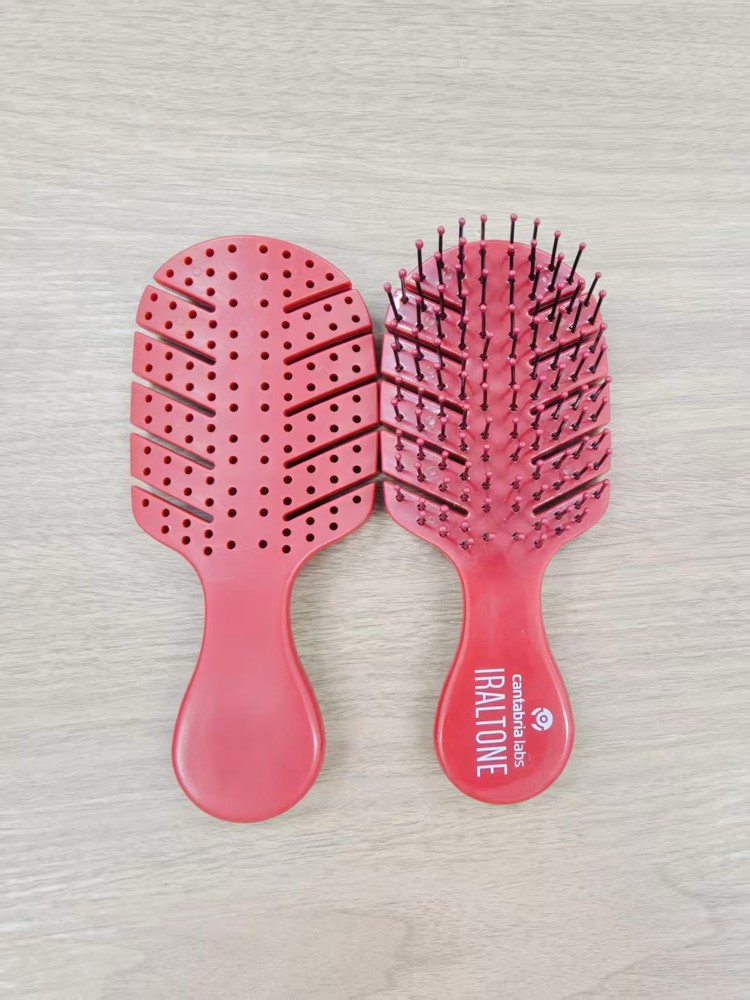
Send your logo file and we will tell you which method holds up better on your chosen brush body — including a printed sample photo before bulk production.
4. Inspect Materials and Quality Control, Not Just Samples
A golden sample means nothing if the next shipment differs. Ask specifically:
- Which materials? Food-grade PP for economical ranges, high-gloss ABS for premium lines, and bamboo/wood for natural product lines. Material choice affects drop resistance, heat tolerance, and finish;
- What QC steps exist? Look for raw material inspection, in-process checks, final drop tests, and bristle-pull tests — not just a "final inspection" claim;
- What is the defect rate policy? Professional manufacturers state an AQL standard and back it with replacement terms.
One detail that separates good factories from average ones: burr-free teeth and cushion pins. It sounds minor until you read a one-star review that says "scratches my scalp."
5. Evaluate Packaging Support — Especially If You Sell Retail
If your brushes sit on retail shelves or ship in e-commerce parcels, packaging is half the product. A manufacturer-focused partner should offer:
- Stock packaging options: half boxes, blister cards, PVC pouches;
- Premium options: gift boxes, display stands for counter retail;
- Free packaging artwork — you send the logo and brand book, their design team prepares print-ready files;
- E-commerce-ready reinforcement for DTC brands shipping via courier.
Ask whether packaging design is in-house or outsourced — turnaround and confidentiality both improve when it is in-house.
6. Check Export Experience and Logistics Location
Private label is a repeat business. Your manufacturer needs to ship reliably, order after order:
- Export track record: which regions do they regularly serve? (Europe, North America, Southeast Asia, and the Middle East each have different documentation and compliance expectations.)
- Port proximity: a factory 30 minutes from Ningbo Port — one of the world's busiest container ports — means more flexible vessel choices, shorter FOB handoffs, and lower inland drayage costs versus inland factories.
- Trade terms flexibility: FOB for experienced importers, CIF/DDP when you want landed-cost certainty.
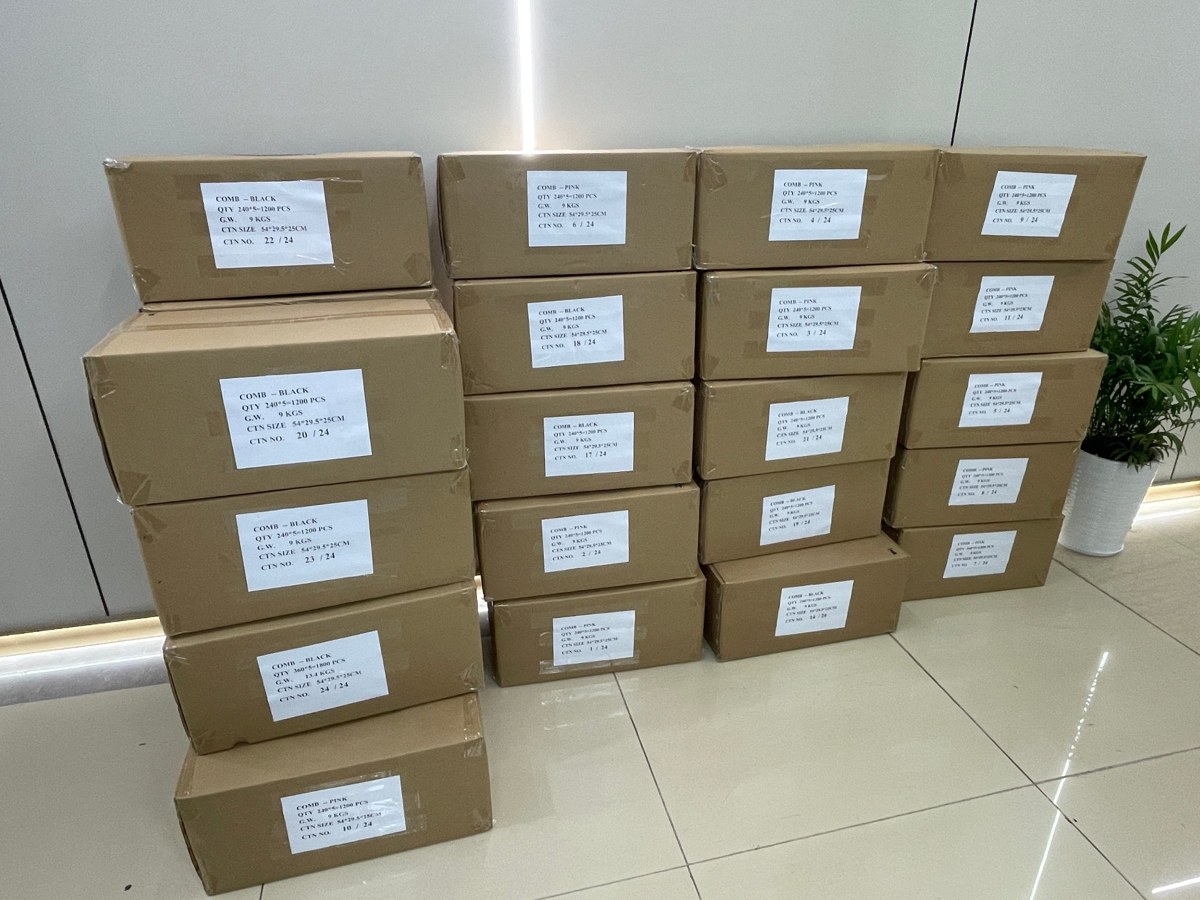
Below is a real export consignment of combs and brushes packed and labeled for one of our private label clients — every carton numbered against the packing list:
7. Assess Communication Speed — Before You Need It Urgently
The cheapest quote is expensive if replies take five days and specs get lost in translation. Before committing, test:
- Do they answer with concrete details (material grades, mold numbers, carton dimensions) or vague marketing lines?
- Do they proactively flag problems — like a packaging artwork issue — or wait until you notice?
- Will one person own your account from sampling to shipment?
Response speed during the quotation stage is the best predictor of their behavior when a container is stuck in customs and you need documents within hours.
Typical Private Label Hair Brush Program: What to Expect
| Stage | Typical Timeline |
|---|---|
| Quotation with customization options | 1–3 working days |
| Pre-production sample with your logo | 5–10 days |
| Bulk production (L1–L3 customization) | 25–35 days after sample approval |
| New custom mold (L4) | Add 15–25 days |
| Shipping (Ningbo → US West Coast, sea freight) | ~15–20 days |
MOQs vary by customization level: stock-model logo printing can start at lower quantities, while fully custom molds follow a different commercial model. Get this table confirmed in writing from any supplier you shortlist.
FAQ: Private Label Hair Brush Sourcing
Q1: What is the typical MOQ for private label hair brushes?
It depends on the customization level. Logo printing on existing molds starts at lower volumes; custom colors require masterbatch minimums; new molds are quoted separately. Share your target quantity and we will recommend the customization level that fits it.
Q2: Can I get samples with my own logo before bulk production?
Yes — this should be standard practice, not a favor. Request a printed sample photo first, then a physical pre-production sample before the bulk run.
Q3: What is the difference between OEM and private label for hair brushes?
Private label usually means applying your brand to an existing (often modified) design. OEM means producing to your own design and specifications, typically involving new tooling. Most retail brands start private label, then move select lines to full OEM as volume grows.
Q4: Which materials are best for detangling brushes?
Flexible TPE cushion structures on PP bodies work well for wet detangling; ABS bodies give a stiffer, premium feel for dry-use styling brushes. The right answer depends on your price point and target consumer — ask your manufacturer to explain the trade-offs in writing.
Q5: How do I protect my custom design from being sold to competitors?
Choose a manufacturer with in-house molds (molds stay under your program), sign an NDA, and confirm mold ownership terms in the contract. Factories that outsource molds have weaker control over where your design travels.
Work With a Manufacturer That Answers These 7 Points in Writing
Since 2005, we at Ningbo Wondew Plastics have produced private label hair brushes, combs, mirrors, and salon tools for brands and distributors in 40+ countries — with in-house mold making, 30+ injection machines, and free packaging artwork on every private label order.
Get our 2026 catalog with full brush and set ranges, item numbers, sizes, and packing photos — or send us your logo for a free mock-up.
Need a hair brush supplier?
We manufacture plastic hair brushes, detangling brushes and hairbrush sets in Ningbo, China. Get factory-direct prices with your logo.
Get a Quote