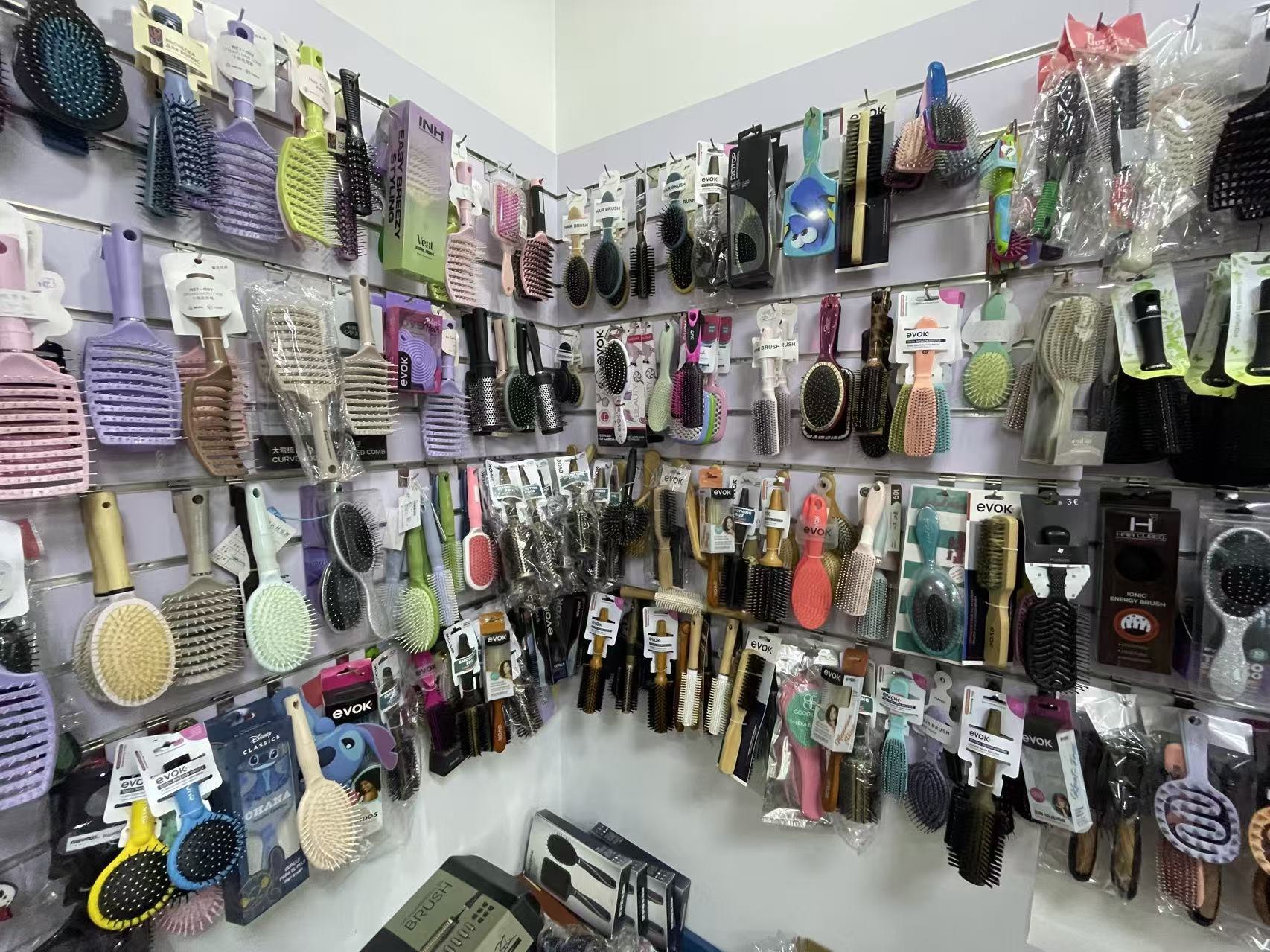
When buyers evaluate a hair brush sample, most of the attention goes to the handle — the color, the shape, the logo area. But the handle is not what your customer's scalp will remember. The bristles are. Bristle type decides how the brush feels, what hair type it serves, where it sits on the retail shelf, and more of the factory cost than most buyers expect.
This guide compares the four bristle systems used in plastic cushion and detangling brushes — nylon pins, boar bristle, boar-nylon mixed tufts, and fine nylon flocking — from the factory side: how each is made, what it costs relative to the others, what quality problems to check for, and which customer segment each one fits.
1. Why Bristle Choice Matters More Than Brush Shape
Brush shape (paddle, cushion, detangling, round) decides the *use case*. Bristle decides the *experience* — and the experience is what drives repeat purchases and reviews.
Three practical consequences for a brand or retailer:
- Price positioning. Two visually identical cushion brushes can sit in completely different price tiers depending on bristle construction. Bristle is one of the biggest cost drivers inside the brush (see our wholesale price guide for the full cost breakdown).
- Return rate. Bristles that shed, scratch, or lose tips generate the returns that quietly destroy a product line's margin.
- Category fit. The same handle can be a mass-market daily brush or a premium salon tool depending only on what is planted into the pad.
So before you pick a mold, pick your bristle system first.
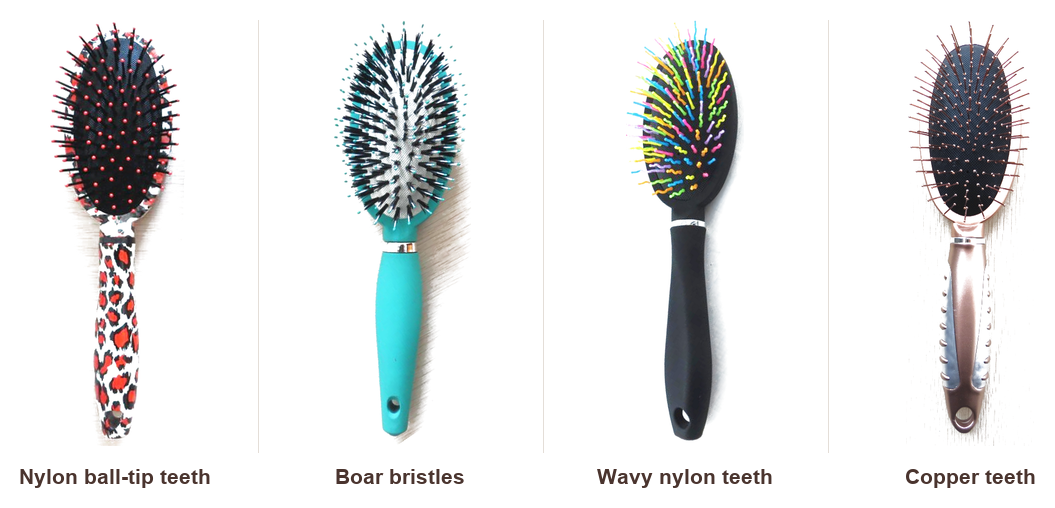
2. Nylon Pins: The Workhorse
What it is. Straight nylon filaments, usually with rounded ball tips, planted in tufts into a rubber cushion or directly into the plastic shell.
Why it dominates. Nylon is consistent, strong, cheap to plant, and available in any color. Tip quality is the main differentiator: a well-rounded tip glides over the scalp; a poorly sealed tip feels sharp after a few weeks of use.
What to check on samples:
- Tip sealing — melt the filament end under a magnifier. A flat or rough cut means the tip will split with use.
- Pull resistance — grab a tuft and pull firmly. Filaments should not come out.
- Diameter consistency — mixed diameters in one tuft usually means blended off-cut material.
Best for: mass-market daily brushes, travel brushes, kids' brushes, any line where durability and cost matter more than shine.
3. Boar Bristle: The Natural Premium Option
What it is. Natural bristle from boar hair, graded by stiffness and length. It is the classic "shine brush": the scaled surface of the bristle picks up sebum from the scalp and distributes it along the hair shaft.
What it does well. Nothing synthetic replicates the polishing effect of natural bristle. For medium-to-fine, relatively straight hair, a boar bristle brush leaves a visible gloss that customers notice immediately — which is why it anchors the premium shelf.
The three realities buyers must handle:
1. Cost and supply volatility. Natural bristle is an agricultural by-product. Grades and prices fluctuate, and consistent grade matching across a production run requires a factory with real sourcing channels — not just a trading middleman.
2. Documentation. For EU and US imports, be ready to discuss origin and sanitary documentation. A serious factory will have this organized; a disorganized one will go quiet when you ask.
3. Customer education. Boar bristle alone is too soft for thick or very curly hair. Your product page and packaging should say who it is for, or you will collect reviews saying "doesn't detangle" — a positioning problem, not a product defect.
Best for: premium daily brushes, shine-focused lines, gift sets, brands with a natural-positioning story.
View our boar bristle hair brush range for how this looks in a finished product.
4. Boar-Nylon Mixed Tufts: The Hybrid That Solves the Trade-off
What it is. One tuft contains both boar bristle and one or two longer nylon filaments in the center.
Why it exists. Pure boar bristle polishes but lacks penetration in thicker hair; pure nylon penetrates but does nothing for shine. The mixed tuft does both jobs at once: the longer nylon pins reach through the hair to detangle at the scalp, while the surrounding boar bristle carries sebum down the hair shaft as the brush passes.
What to check on samples:
- Nylon must sit slightly proud of the boar bristle — if the nylon is shorter, the brush detangles nothing.
- Ratio consistency. Tufts where the boar-to-nylon ratio visibly varies across the pad will feel uneven in use.
- Color matching. Natural bristle tone varies between batches; if your line requires a uniform look, confirm the factory can hold the shade across reorder cycles.
Best for: mid-to-premium brands that want one brush to serve "normal to thick" hair — the most versatile bristle system in the cushion category, and a very common choice for private label programs.
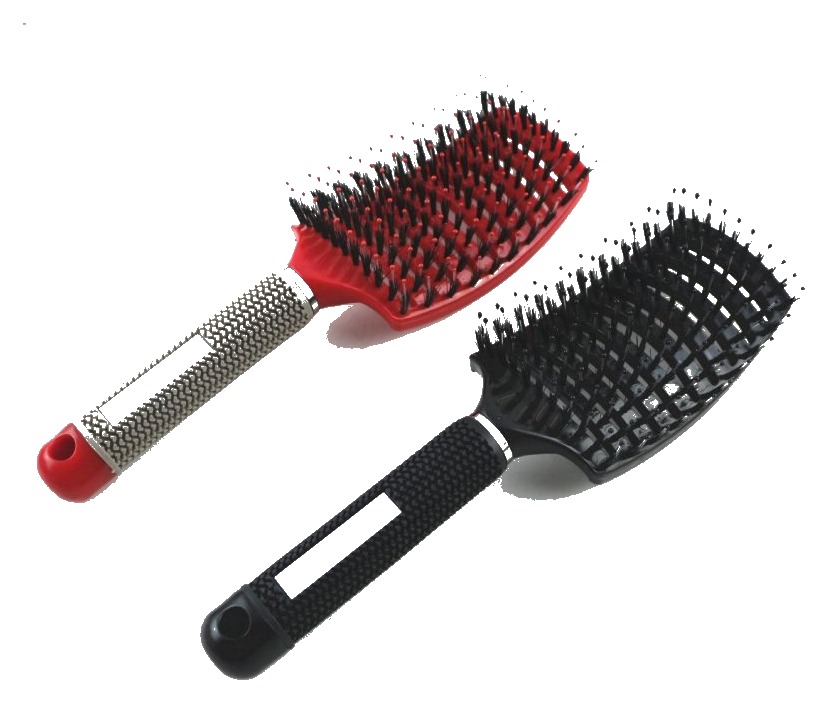
5. Fine Nylon Flocking: The Detangling Category
What it is. Thousands of short, thin, flexible nylon filaments applied densely by flocking (electrostatic planting) rather than tufting. This is the bristle system behind the "wet brush" / detangler category that reshaped the mass market over the past decade.
Why it works. Thin flexible filaments bend under load, so they glide through wet, vulnerable hair instead of dragging through it. Density does the work: the brush behaves soft on the scalp but still separates strands effectively.
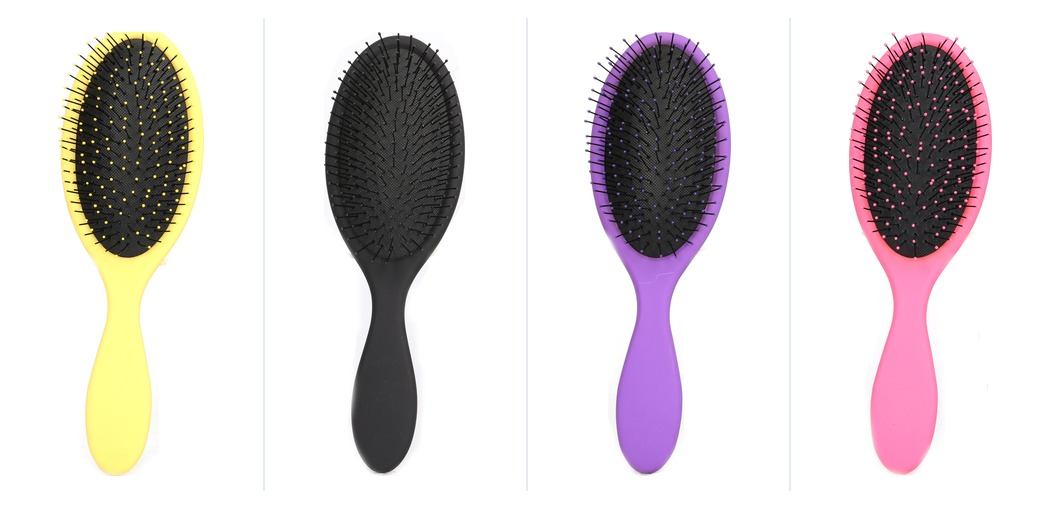
What defines a good flocked brush — and what defines a bad one:
- Filament thinness and taper. The flexibility comes from fine diameters. Cheap versions use thicker filaments and simply lose the wet-hair glide.
- Flocking density and uniformity. Patchy density shows as visible "bald" areas on the pad and creates uneven drag.
- Anchor quality. Flocked filaments are held by adhesive in the base. Weak adhesive means shedding within weeks — the single most common quality complaint in this category.
We produce this construction in-house (molding, flocking, assembly all in one factory). Our model WDH2351 — a fine-flocked detangling cushion brush — is the reference sample we send buyers evaluating this category: it shows the filament fineness, density and anchor quality that the wet-brush shelf expects. See also our detangling brush range and the shape-level comparison in detangling brush vs paddle brush.
Best for: mass-market detangling lines, wet-use brushes, kids' lines, any product where "glides through wet hair" is the core selling claim.
6. Cost Structure at a Glance
Consistent with our price guide, we give relative cost structure, not unit prices — every real quote depends on pad size, tuft density, handle material and quantity.
| Bristle system | Relative cost index | Main cost driver | Quality risk to control |
|---|---|---|---|
| Nylon pins | 100 (baseline) | Filament grade, tip sealing | Sharp tips, tuft pull-out |
| Fine nylon flocking | ~110–130 | Flocking process, filament fineness, adhesive | Shedding, patchy density |
| Boar-nylon mixed | ~140–170 | Boar grade and supply, dual-planting labor | Ratio inconsistency, shade drift |
| Pure boar bristle | ~160–200+ | Boar grade, grading labor, sourcing channel | Grade mixing, documentation gaps |
Read the table with one insight in mind: the jump from nylon to any natural-bristle system is driven by material sourcing and skilled planting labor, not by machinery. That is why the price gap between suppliers widens fastest in this zone — a factory with stable bristle channels quotes differently from one buying bristle per order.
7. Matching Bristle to Your Customer Segment
| Your segment | Recommended system | Why |
|---|---|---|
| Mass retail, competitive price | Nylon pins / fine flocking | Durability at cost, proven review profile |
| Detangling / wet-use claim | Fine nylon flocking (WDH2351 reference) | Category expectation, wet-hair glide |
| Mid-premium daily line | Boar-nylon mixed | One SKU serves more hair types |
| Premium / gift / salon | Pure boar or boar-nylon | Visible gloss effect justifies the shelf price |
| Kids | Fine flocking or soft nylon | Scalp-friendly, low pull |
| Travel / promo | Nylon pins | Cost ceiling is tight; reliability still matters |
A practical rule for a first private label order: launch with one bristle system per collection, not one brush per bristle system. A three-piece set all in boar-nylon mixed outsells three single brushes in three different systems, because the set reads as a coherent product story — and packaging cost behaves better too (see hair brush set).
8. Quality Checkpoints Before You Place the Order
Whatever system you choose, put these five checks in your sample approval — they catch the failures that later become returns:
1. Pull test. Firm pull on 10 random tufts (or patches, for flocking). Zero filaments released.
2. Shed simulation. Brush a wool cloth 50 strokes; inspect for loose filaments on the cloth.
3. Tip inspection. Every nylon pin tip rounded and sealed — magnifier, 100% of sampled tufts.
4. Density map. For flocked pads: no visible thin patches when held against a light.
5. Cushion adhesion. For cushion brushes: pad edges fully bonded; try lifting a corner with a fingernail — it should not start.
A factory that welcomes these checks is a factory you can reorder from. One that resists them has told you something already.
FAQ: Hair Brush Bristle Types
Is boar bristle really better than nylon?
Better for a specific job: distributing natural oils and adding shine on normal-to-fine hair. Nylon is better for detangling thick hair and for wet use. They are tools for different claims, not competitors on the same claim.
What bristles do wet or detangling brushes use?
Fine nylon flocking — thousands of thin, flexible filaments planted densely. The flexibility and density together produce the wet-hair glide. See model WDH2351 for a factory reference of this construction.
Why do mixed boar-nylon brushes cost more than either pure type?
Two planting operations in one tuft plus natural bristle grading and sourcing. You are paying for process complexity and material handling, not just material.
Do boar bristle brushes shed?
All natural bristle sheds slightly at first — a few loose hairs in early use is normal. Ongoing visible shedding after the first weeks means grade mixing or weak anchoring, and is a quality defect.
Which bristle should I choose for my first private label brush?
Boar-nylon mixed if your customer is a general hair-care buyer; fine flocking if your claim is detangling or wet use; nylon pins if your price ceiling is tight. Confirm the segment first, then the system.
Ready to Spec Your Bristle?
Send us your target segment, price positioning and market — we will recommend a bristle system, send the corresponding reference sample (including WDH2351 for fine flocking), and quote against the same cost structure you just read about.
- WhatsApp: +86 159 5749 9644
- Email: info@wondew.com
- Factory: Ningbo, Zhejiang, China — contact page
*Related reading: Detangling brush vs paddle brush · Hair brush wholesale price guide · Private label hair brush manufacturer guide · How to choose hair brushes for retail*
*Related products: Boar bristle hair brush · Detangling brush · Hair brush set*
Need a hair brush supplier?
We manufacture plastic hair brushes, detangling brushes and hairbrush sets in Ningbo, China. Get factory-direct prices with your logo.
Get a Quote